Beyond church walls and man-made rules—seeking Christ, not religion.
Introduction to the Series
Faith has always been a central part of my life, but over the years, I’ve wrestled with how religion has evolved. Christianity, the faith I hold dear, has undergone immense transformation from its earliest days to what it is now. What started as a simple, faith-driven community has become an institution with layers of doctrine, traditions, and denominational divides.
In this series, I want to explore what the early church looked like just after Jesus’ ascension and how it changed over time. My goal is not to discredit the modern church but to reflect on its origins, the challenges it faced, and how those early believers lived out their faith. By the end of this series, I hope to provide insight into where Christianity has been and encourage a return to its foundational principles of love, service, and truth.
The Birth of the Church
Jesus’ Ascension and the Coming of the Holy Spirit (Pentecost)
After His resurrection, Jesus spent forty days with His disciples, teaching them about the Kingdom of God. Before ascending into heaven, He gave them the Great Commission, commanding them to go and make disciples of all nations (Matthew 28:19-20). He promised that they would receive the Holy Spirit, who would empower them to be His witnesses.
Ten days later, on the day of Pentecost, the Holy Spirit descended upon the disciples in Jerusalem (Acts 2:1-4). This moment marked the true beginning of the church. The Spirit gave the apostles the ability to speak in different languages, allowing them to preach the Gospel to people from all over the known world. Thousands were converted that day, forming the first community of believers.
The Apostles’ Role in Spreading the Gospel
The apostles, particularly Peter, John, and later Paul, played a critical role in establishing and spreading Christianity. Peter boldly preached in Jerusalem, leading to the conversion of many Jews. Paul, once a persecutor of Christians, experienced a radical transformation and became the primary missionary to the Gentiles, spreading the Gospel throughout the Roman Empire.
The apostles traveled extensively, planting churches and writing letters that would later become part of the New Testament. Their teachings focused on the message of Christ’s death and resurrection, salvation by faith, and the call to live in love and unity as the body of Christ.
House Churches and Communal Living
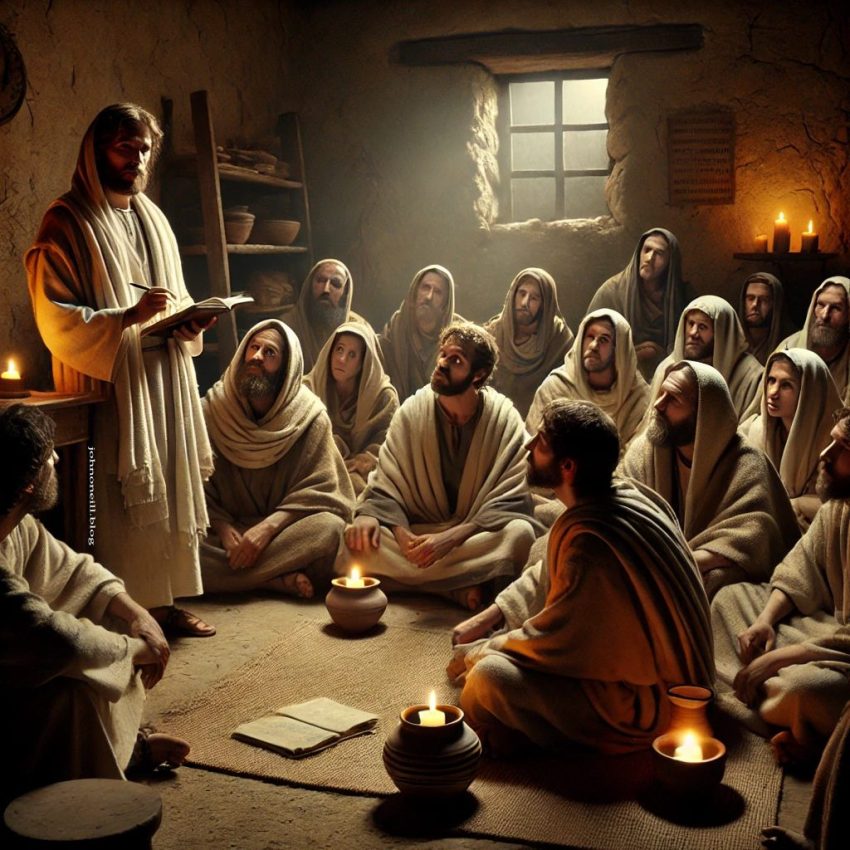
Unlike today’s formal church buildings, early Christians met in homes. They gathered to break bread, pray, and study the apostles’ teachings (Acts 2:42-47). These house churches were small, intimate communities where believers supported one another financially, emotionally, and spiritually.
They practiced radical generosity, ensuring that no one among them was in need. Wealthier believers would often provide for those who had little, and the community functioned as a family. This unity and selflessness became a hallmark of the early church.
Persecution and Growth
Opposition from Jewish Leaders and the Roman Empire
The rise of Christianity was met with immediate opposition. Jewish religious leaders saw it as a threat to their authority, leading to the arrest and execution of early Christians, including Stephen, the first Christian martyr (Acts 7:54-60). Paul himself, before his conversion, was a zealous persecutor of the church.
As Christianity spread beyond Jerusalem, it encountered fierce resistance from the Roman Empire. The refusal of Christians to worship the Roman gods and the emperor led to their persecution. Nero, one of the most infamous emperors, blamed Christians for the Great Fire of Rome and subjected them to brutal executions, including being thrown to lions or burned alive.
Martyrdom and the Spread of Christianity
Ironically, persecution only fueled the growth of Christianity. The steadfast faith of martyrs inspired many, demonstrating that Christians were willing to die rather than renounce their beliefs. Tertullian, an early church father, famously wrote, “The blood of the martyrs is the seed of the church.”
Despite the dangers, Christianity spread rapidly across the Roman world. Underground churches formed, secret symbols like the ichthys (fish) were used to identify fellow believers, and the faith took root in diverse communities, from slaves to Roman officials.
How Early Christians Lived Out Their Faith
The early Christians stood out because of their love and service to others. They cared for widows, orphans, and the poor, often at great personal cost. During plagues and famines, while many fled, Christians stayed to care for the sick, showing Christ’s love through their actions.
Their moral and ethical teachings also set them apart. They rejected practices like infanticide, gladiator games, and immorality, embracing a countercultural lifestyle that reflected Christ’s teachings.
The Simplicity of Early Christianity
No Established Denominations, Just Faith in Christ
One of the most striking aspects of the early church was its unity. There were no denominations, theological divisions, or doctrinal disputes over minor issues. The focus was solely on Jesus—His death, resurrection, and the promise of salvation. Faith in Him was the foundation of Christianity.
The apostles emphasized a personal relationship with Christ, not adherence to a religious institution. They taught that salvation was by grace through faith, not by works or rituals (Ephesians 2:8-9).
Emphasis on Love, Service, and the Gospel Message
Jesus taught that love was the greatest commandment, and the early church embodied this principle. They loved God and each other selflessly, living out their faith through acts of service. Evangelism was not just about preaching; it was about demonstrating Christ’s love in daily life.
The Gospel message was simple yet powerful: Jesus Christ died for sins, rose again, and offers eternal life to those who believe in Him. There were no complex theological debates—just a call to repentance, faith, and a transformed life.
The Contrast Between the Early Church and Later Institutionalized Religion
As time passed, Christianity evolved into an institution with hierarchies, rituals, and traditions. While some of these changes were necessary for organization, others led to power struggles and legalism that strayed from the early church’s simplicity. The faith that once thrived in homes and small communities became tied to political structures and formalized religion.
Reflecting on the early church reminds us of what truly matters: faith in Christ, love for others, and living a life that reflects the Gospel. Perhaps modern Christianity can learn from its roots and return to the essence of what Jesus intended His church to be.
Conclusion
The early church was a movement, not an institution. It was marked by faith, love, and a willingness to suffer for Christ. As we continue this series, we’ll explore how Christianity changed over time, for better and for worse. My hope is that by looking at the past, we can gain clarity on what it truly means to follow Jesus today.